
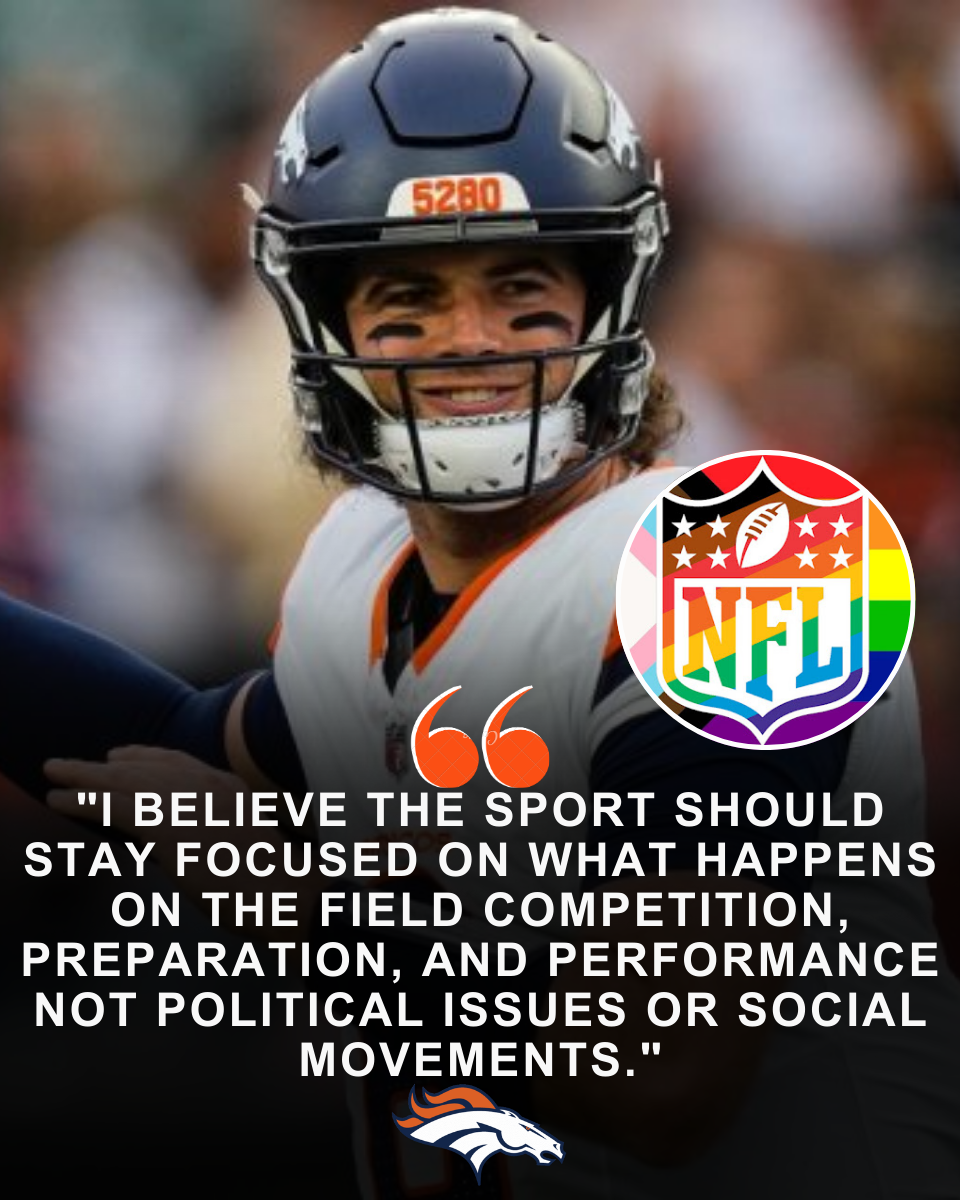
The NFL universe is imagined to be engulfed in one of its most intense and emotionally charged debates of the season after Denver Broncos quarterback Jarrett Stidham reportedly announced that he will not participate in the league's upcoming "Pride Night" event, instantly thrusting a familiar name into the center of a national conversation far bigger than football itself.
In this fictional storyline, the announcement landed without warning and without theatrics, yet the impact was immediate and explosive, spreading across social media platforms, sports networks, locker rooms, and fan communities within minutes.
There was no dramatic press conference, no viral video, no elaborate explanation, just a firm decision that rippled outward and refused to stay contained.

Jarrett Stidham is not the most famous quarterback in the NFL, but in this imagined universe, that's exactly what makes the story even more volatile.
Because when a superstar speaks, people expect headlines.
But when a player who exists on the edge of the spotlight suddenly becomes the center of the league's biggest cultural debate, it creates a strange, uncomfortable tension that pulls in everyone.
In Denver, the quarterback position is always under a microscope.
Always.
And in this fictional narrative, Stidham's decision immediately became bigger than Stidham himself, because it wasn't just about a Pride Night appearance.
It became a symbol.
A test.
A litmus moment for how the Broncos, their locker room, and their fanbase would respond.
In this imagined storyline, sources close to Stidham described the decision as deeply personal, rooted in his desire to remain authentic to his own values while maintaining respect for others.
However, in the modern sports ecosystem, intention rarely controls interpretation.
Reaction does.
And the reaction was immediate, emotional, and deeply divided.
Supporters of Stidham in this fictional scenario quickly rallied around him, arguing that participation in league-sponsored initiatives should never be mandatory and that true inclusion cannot be enforced through obligation.
They emphasized personal agency, freedom of conscience, and the idea that respect does not require public participation in every symbolic event.
Others, however, reacted with disappointment and frustration, viewing the decision as a missed opportunity for visible allyship at a time when representation still matters deeply to many fans and players.
They argued that Pride Night is not merely ceremonial, but a statement of welcome to communities that have long felt excluded from professional sports.
In this fictional storyline, advocacy groups issued statements underscoring the importance of visibility from high-profile athletes, stressing that even if no harm was intended, absence from Pride Night can resonate loudly with fans who already feel unseen.
The debate escalated quickly because quarterbacks are different.
They are not treated like other players.
They are not allowed to be invisible.
They are expected to lead.
They are expected to represent.
And they are expected to understand that every public decision becomes part of the team's image.
In this imagined narrative, critics argued that if Stidham wanted to avoid controversy, he should have handled the situation privately rather than making a public announcement.
But defenders pushed back, arguing that he had every right to be honest, and that forcing players to quietly comply is exactly how hypocrisy grows inside professional sports.
Social media, in this fictional universe, transformed the decision into a battlefield.
Short clips stripped of context spread rapidly.
Hashtags surged.
Opinions hardened.
And within hours, the discussion was no longer about a single event.
It became a larger argument about the NFL's relationship with social causes and the expectations placed on players.

Inside the Broncos organization, this fictional scenario suggests a careful balancing act.
Team officials publicly reaffirmed their commitment to inclusivity and respect for all communities while also emphasizing that players are individuals with the right to make personal decisions.
It was a statement designed to calm tensions.
It did not.
Teammates, in this imagined universe, responded in varied ways.
Some openly voiced support for Pride Night and emphasized solidarity with LGBTQ+ fans.
Others chose silence, perhaps recognizing the complexity of the issue or wishing to avoid being pulled into a controversy that was rapidly spiraling beyond control.
The locker room, once a place of football focus, became a space where unspoken tension lingered.
Sports media seized the moment.
Panel shows dissected every angle.
Commentators debated intent versus impact.
Former players weighed in with conflicting perspectives, some urging compassion and understanding, others warning that opting out of inclusion initiatives carries consequences whether intended or not.
In this fictional narrative, critics questioned whether the NFL has reached a critical crossroads.

Can the league continue to champion social initiatives while allowing prominent players to step aside from them?
Does inclusion lose meaning if it is optional?
Or does forced participation undermine authenticity?
These questions dominated headlines and conversations alike.
Supporters of Stidham argued that authenticity is precisely what makes leadership credible.
They insisted that genuine respect cannot be legislated and that pressuring players into symbolic acts risks turning meaningful causes into hollow gestures.
Opponents countered that symbolism matters because it shapes culture, and that absence from such moments can reinforce feelings of exclusion, regardless of personal intent.
In this imagined scenario, the league office monitored the situation closely, aware that how it responds could set a precedent for future initiatives.
The NFL has long attempted to balance football, business, and social responsibility, but moments like this expose just how fragile that balance truly is.
Because football may unite millions on Sundays.
But culture divides them the rest of the week.
Jarrett Stidham, in this fictional universe, remained largely quiet after the initial announcement, allowing the conversation to unfold without adding fuel.
That silence was interpreted in multiple ways.
Some saw it as discipline and restraint.
Others viewed it as avoidance.
Once again, silence became its own narrative.
Fans across the league found themselves confronting uncomfortable questions.
Can a player be respected without agreeing with every league initiative?
Can the NFL promote inclusion without demanding uniform participation?
Is disagreement itself a form of disrespect, or a natural part of a diverse league?
These questions refused to fade.
In this imagined storyline, the controversy reached beyond football entirely, touching on broader societal debates about identity, representation, and individual conscience.
It became clear that the NFL is no longer just a sport.
It is a platform.
And platforms amplify everything.
The story does not end with resolution, because in this fictional scenario, there is none.
Only ongoing debate.
Only entrenched positions.
Only the reality that modern athletes operate in a world where every decision carries meaning far beyond the scoreboard.
Whether Jarrett Stidham intended to ignite one of the most polarizing discussions of the season or not, the imagined fallout underscores a simple truth.
In today's NFL, a player's legacy is no longer shaped only by touchdowns, wins, and statistics.
It is shaped by how decisions resonate in a world watching closely, listening carefully, and arguing endlessly.
And once a conversation like this begins, it does not end quietly.